
Meet the Grantee: Dr. Swathi Sudhakar
Engineering multifunctional protein-based micromotors and resolving propulsion mechanics using holographic optical tweezers
What if tiny micromotors could one day travel inside the human body to deliver drugs exactly where they’re needed? In her interview, our Short Term Grantee Dr. Swathi Sudhakar from Indian Institute of Technology Madras, India —hosted by Prof. Holger Kress, Department of Physics —talks about this bold vision, surprising turning points in her career, and why Bayreuth was the perfect place to push these ideas forward.
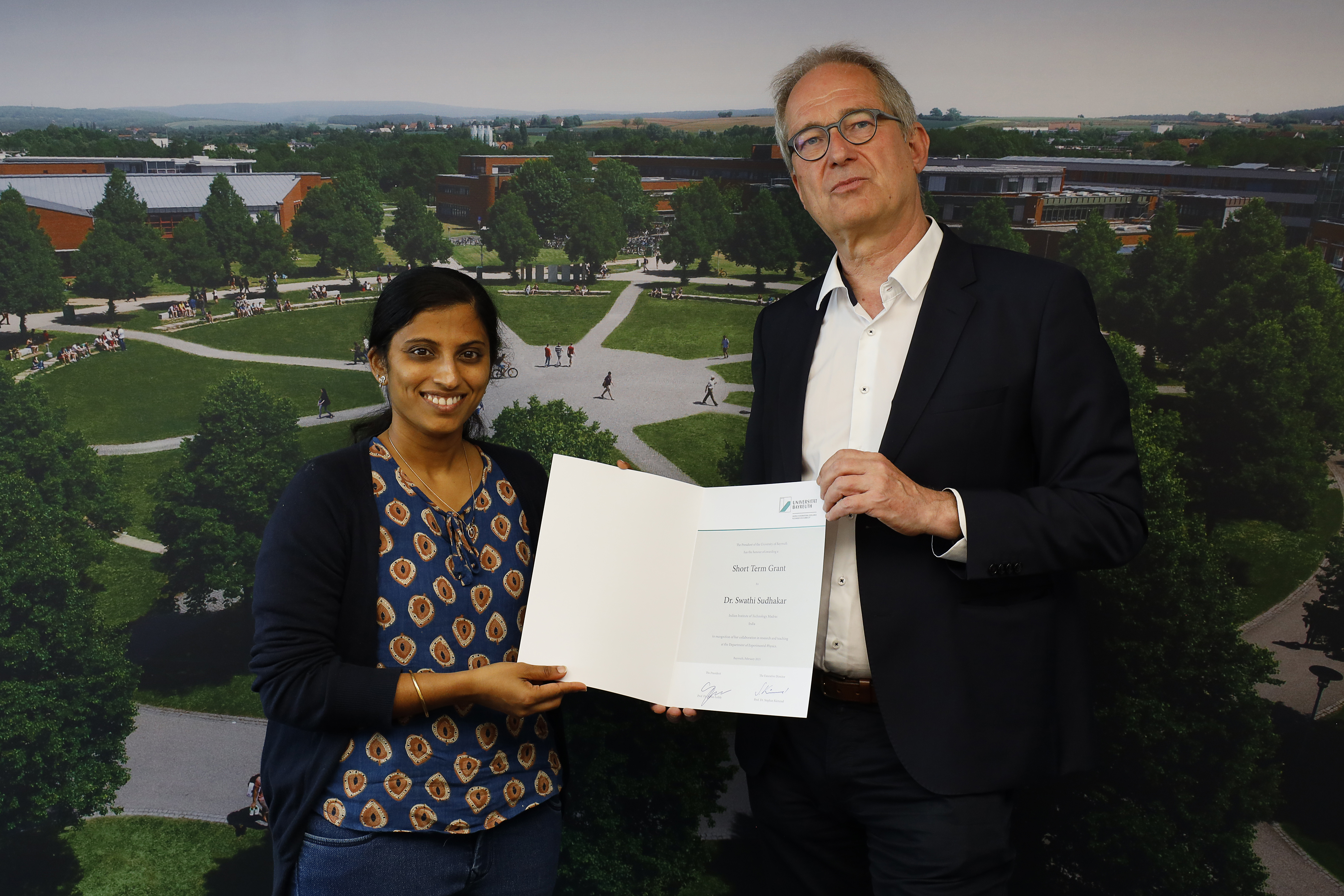
Dr. Swathi Sudhakar and Prof. Dr. Stefan Leible, President of the University of Bayreuth
If you had to explain the research project of your Short Term Grant to the person you metin the elevator, how would you describe it?
Swathi Sudhakar: The ultimate goal of my research career is to develop advanced micro/nanorobots that could one day deliver therapeutic drugs autonomously at hard to reach sites in the human body, thereby completely replacing the conventional drug delivery routes that induce severe side-effects and co-morbidities. However, research on such small-scale robots/motors is in its nascent stage and questions such as how these micromotors interact and move within the cellular environment are yet to be answered. Hence, my research focus during my research stay at the University of Bayreuth was to answer these critical questions by unravelling the micromotor force interactions within cell-mimicking environments. In brief, this research aimed to investigate the self-propulsive mechanics of protein-based micromotors encapsulated within giant unilamellar vesicles (GUVs), which serve as cell-mimicking models. The propulsion mechanics was elucidated using holographic optical tweezers (HOT) present in the host's laboratory that offers high resolution force measurements upto pico and sub-piconewton level which are the self-propulsion force ranges achieved by micro/nanomotors.
Was there a special moment in your life that made you decide for your research focus?
Swathi Sudhakar: Yes. During my doctoral tenure, my research focus was onto unravelling the dynamics of molecular motor proteins specifically kinesin using high-resolution optical tweezers. It was at that time I realized the enormous complexity of biological systems at the cellular and tissue level. There has to be a paradigm shift in our therapeutic approaches to overcome such biological complexity for treating diseases like cancer that burden the global healthcare system. Existing treatment modalities for cancer mostly revolve around chemotherapeutic drugs administered through conventional delivery routes. However, these drugs face severe difficulty in reaching and penetrating tumour tissues efficiently. That challenge stayed with me. Then, the moment I heard about micromotors moving autonomously through complex biological environment, I knew I had found my direction by creating actively propelling drug carriers instead of conventional nanomedicine. That became the turning point for my research focus.
What is in your opinion the future of your field? In what way can research in your field contribute to meeting the urgent challenges of our time?
Swathi Sudhakar: I strongly believe that the future of pharmaceutical industry will involve the development of personalized nanomedicine capable of reaching the target site and delivering the pharmaceutically active component in a safe and efficient manner. Micro/nanomotors are the superior class of nanomaterials having the ability of directional and controlled locomotion which can be precisely guided to the target site by traversing through complex biological fluids. Hence, research in micro/nanomotors can revolutionize targeted drug delivery by improving therapeutic precision, reducing side effects, and overcoming biological barriers that limit current treatment modalities. In the upcoming years, many active motion exhibiting drug carriers are about to approved by regulatory bodies and even more of them are to be taken into clinical trials which reiterates that the entire therapeutic landscape will see the rise of such materials.
What does international research mobility in today's world mean to you?
Swathi Sudhakar: According to me, international research mobility means scientific growth extending beyond boundaries. It has always been the central component of my research career. My research vision of developing advanced nanomedicinal solutions for globally burdening diseases like cancer requires interdisciplinary collaboration and scientific feedback that cannot be just limited to my home institution. Through international research mobility programmes, I aim to build collaborations, learn from new perspectives, and utilize modernistic equipments which would not be possible otherwise. Further, the outcomes of such mobility programmes are proofs that science advances fastest when knowledge moves across borders, not when it stays confined within them.
What was your personal experience during your stay?
Swathi Sudhakar: My research stay at the University of Bayreuth was both personally enjoyable and professionally insightful. My host Prof. Dr. Holger Kress was supportive and helped me throughout my stay. I had a wonderful experience with my host with many informative conversations about the current research work and beyond. Moreover, I had fruitful interactions with his research team who never hesitated in helping me to conduct my research activities. I had a great liking towards the functioning of the entire institution and its rejuvenating environment. I am grateful to the Bayreuth Humboldt Centre for awarding me the prestigious short term grant.
The Grantee
Dr. Swathi Sudhakar is an assistant professor working at the Department of Applied Mechanics and Biomedical Engineering, Indian Institute of Technology Madras, India. Her research focus is on the integration of single molecule biophysics and nanotherapeutics for developing targeted, affordable, and scalable treatment strategies. Till date, she has published 48 peer-reviewed research articles in reputed international journals and hold 8 granted patents with an additional 26 patents currently filed, reflecting her strong commitment to translational research and technology development. Her major recognitions include the Merck Young Scientist Award in 2025, nomination by the Government of India to the BRICS Young Scientist Forum in 2024, and the Young Scientist Award in Biological Sciences by the Academy of Sciences in 2025.