
Meet the Fellow: Dr. Frank Ejby Poulsen
Hermann Conring and the Legal History of the Holy Roman Empire
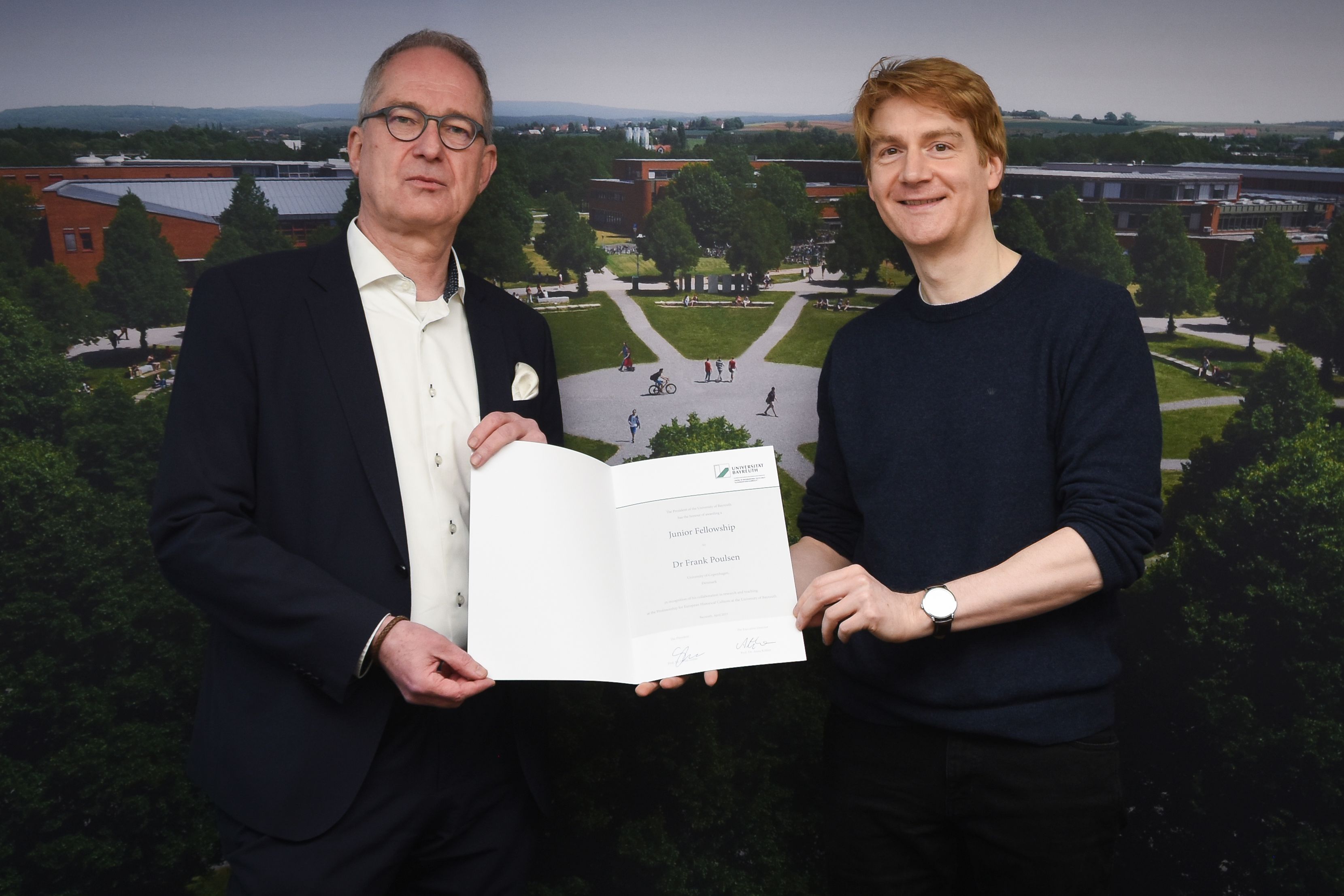
Dr. Frank Poulsen and Prof. Dr. Stefan Leible, President of the University of Bayreuth
If you had to explain the research project of your Fellowship to the person you met in the elevator, how would you describe it?
Frank Poulsen: I’m interested in understanding how an academic discipline or field appeared, developed its scientific apparatus, and established itself institutionally. Of particular interest are disciplines that shape societies’ structures. In this case, I am focusing on legal history, which has been a mandatory subject for all law students since the second half of the nineteenth century. One figure considered as the godfather of legal history as a discipline is Hermann Conring (1606-1681), a polymath who was professor at the then university of Helmstedt. Conring was trained in and taught medicine and natural philosophy, but he turned to law and decided to teach the constitutional origins of the Holy Roman Empire. He made a controversial argument at the time that the Holy Roman Empire was not a continuation of the Roman empire by using a historical analysis. What led him to do so? Why did he use history for his argument? Did he intend to found a new discipline doing so? My research project analyses his teachings and published writings within their intellectual context to answer these questions. For the intellectual context, the content of his library is a central source.
Was there a special moment in your life that made you decide for your research focus?
FP: This specific focus on an intellectual history of legal history is the result of chance encounters during my postdoctoral years. My PhD is in intellectual history, but I also studied law. For my postdoc, I taught legal history and I worked on a case-study with a group of researchers focusing on privacy in seventeenth-century Helmstedt. This is how I discovered Hermann Conring, who was a professor there. The idea of writing an intellectual history of legal history is the result of readings and conversations. The literature suggests that an intellectual history of legal history still awaits. My conversation with legal historians further led me to consider how and why this discipline evolved as part of the standard curriculum for law students. Law and history are tightly related to sovereign power and therefore this is a discipline whose emergence and evolution is crucial to study, especially for building projects such as a liberal democratic European Union or global justice in the international community.
What is in your opinion the future of your field(s)? In what way can research in your field(s)contribute to meeting the urgent challenges of our time?
FP: The world is experiencing a strong revival of anti-intellectualism, enhanced by the digital revolution and AI algorithms that foster echo chambers and polarization. This is obviously challenging a field called "intellectual history", which has (too) long focused on, well, "intellectual" authors and topics. The emerging field of the history of knowledge is promising because of its "non-intellectual" take on what constitutes knowledge and the actors who produce and circulate it. By focusing on the constitution of academic disciplines and private libraries, it can provide a healthy appraisal of authority in knowledge formation and circulation, as well as a more truthful description of what people actually read, discussed, and thought. Moreover, combined with digital humanities, the history of knowledge--like other academic disciplines--can become more open to a larger public and become more collaborative and interdisciplinary. An archive is no longer the property of a specialist historian, but can be transformed into standardized data sets for all to analyze with various approaches and questions.
What does international research mobility in today's world mean to you?
FP: It is crucial to travel to non-English speaking countries because a lot of the research and many innovative methods or questions are not translated into English (the current lingua franca of science). It enables a wider variety of views and access to research and foci that are not readily available to non-English speakers. This is important to me on two grounds. First, because I research Early Modern European intellectual history, and therefore try to gain a broader perspective of the views of the world from several powerful countries in the seventeenth and eighteenth centuries. Second, and here the research feeds the individual and political point of view, because constructing a peaceful and stable Europe requires us as individuals to construct ourselves as Europeans and learn from one another, our languages, histories, and cultures, to understand what forms Europe’s unity and diversity. To me, it has so far been a great source of personal discovery to navigate different scholarly traditions and rich histories by living in France, England, the USA, Denmark, Spain, Austria, Italy, and Germany. It will eventually pay off in a future monograph.
What were your expectations when you applied for the Fellowship?
FP: As any scholar--especially an early career one--knows, one should not expect much from an application. Grant institutions receive overwhelming amounts of highly qualified applications and excellent research projects for only a few available grants. I don't think a rejection necessarily reflects on the quality of a proposal, but perhaps more on its timing and the foci that an institution decide to place emphasis on. Is this question or idea relevant to our current state of knowledge? Will it contribute to important debates today? Does it have wider implications in other fields? These might be the questions that reviewers consider when making tough selections. I have several research projects and ideas, for which I prepared time-consuming proposals. My goal, therefore, is simply to test the waters to see which directions senior researchers think should be followed. To me, it makes my life easier by having peer-reviewed proposals and more experienced scholars pointing to me which ideas and projects are worth pursuing right now. In this case, a history of an academic discipline that has been central to the formation of the nation-state and the international legal system: legal history.
What was your personal experience during your stay?
FP: I stayed in Bayreuth and in Bamberg, as my host institution (Institut für Fränkische Landesgeschichte) is affiliated with both. I loved the Markgräfliche Opernhaus and its impressive baroque interior, contrasting with its understated façade. The catacombs also made an impression on me — I had not expected them to be linked to beer history, especially since I grew up in Paris, home to other famous catacombs that have nothing to do with beer. I enjoyed gallivanting in the beautiful nature that Franconian Switzerland has to offer, particularly discovering the cherry blossom hike.
If you could choose a famous researcher or scientist to have dinner with, who would it be?
FP: If not the object of my study, Hermann Conring (1606-1681), I’d go with another early modern polymath: Conrad Gessner (1516-1565), a Swiss naturalist. Gessner attempted to catalogue all known knowledge at the time, which is fascinating as it grapples with a very contemporary problem of ours: how do we organise and make sense of an overwhelming amount of information? Before databases and computers, I would like to discuss with him how he decided to select his data and why he would chose to leave out some data and how to catalogue the selected information.
Have you noticed any differences or similarities between UBT and your home university?
FP: UBT is only 50; it is therefore modern and has a dedicated campus where all faculties and departments are concentrated, which is not the case for older ones. However, my home university, which I would consider to be Copenhagen, although I do not have a home university, has also been moving in that direction by concentrating its faculties in campuses around general fields of knowledge: a campus for the humanities, one for the social sciences (to be merged with the humanities), a campus for the natural sciences, one for the agricultural sciences, and the historic buildings in the centre for the central administration. As a historian focusing on knowledge, I am aware of the connection between the conception of knowledge and its expansion. It is, in my view, more fruitful not to separate various fields of knowledge too strictly; concentrating expertise in one place helps foster interdisciplinarity and, therefore, a democratic and liberal spread and application of knowledge. This is crucial for our information age when technology gathers big data on individuals whilst the humanities are under attack.
The Fellow
Frank Ejby Poulsen is Danish and French. He holds a PhD in history from the European University Institute in Florence, Italy (2018), a MSc in political science from the University of Copenhagen (UCPH), and an LLM and LLB from the University of Paris 1 Panthéon-Sorbonne. His monograph “The Political Thought of Anacharsis Cloots” won the De Gruyter 10th anniversary of Open Access competition and was published in OA in November 2023. He has published peer-reviewed articles in intellectual history, art history, and the history of knowledge. From 2019-2022, he was a postdoctoral researcher at the Danish National Research Foundation’s Centre for Privacy Studies, UCPH. From 2023-2024, he won a María Zambrano research grant for the attraction of international talents to Spain, at the research group CINTER (Court, Image, Nobility, Territory), King Juan Carlos University, Madrid. He won research grants in Germany, and a visiting grant to UC Berkeley. He has taught political theory, the history of political thought, legal history, legal sociology, legal philosophy in Denmark and cultural heritage and institutional protocols in Spain.