
Meet the Grantee: Kayode Oshinubi
Functional Data Analysis: a wholistic approach to spatial variations in vaccination data
Short‑Term Grantee Kayode Oshinubi from Northern Arizona University (USA) reflects on his work using wastewater data to better understand and forecast viral disease dynamics. Hosted by Prof. Dr. Melanie Birke at the Chair of Stochastics and Machine Learning, he describes how international collaboration broadened both his scientific and personal horizons.
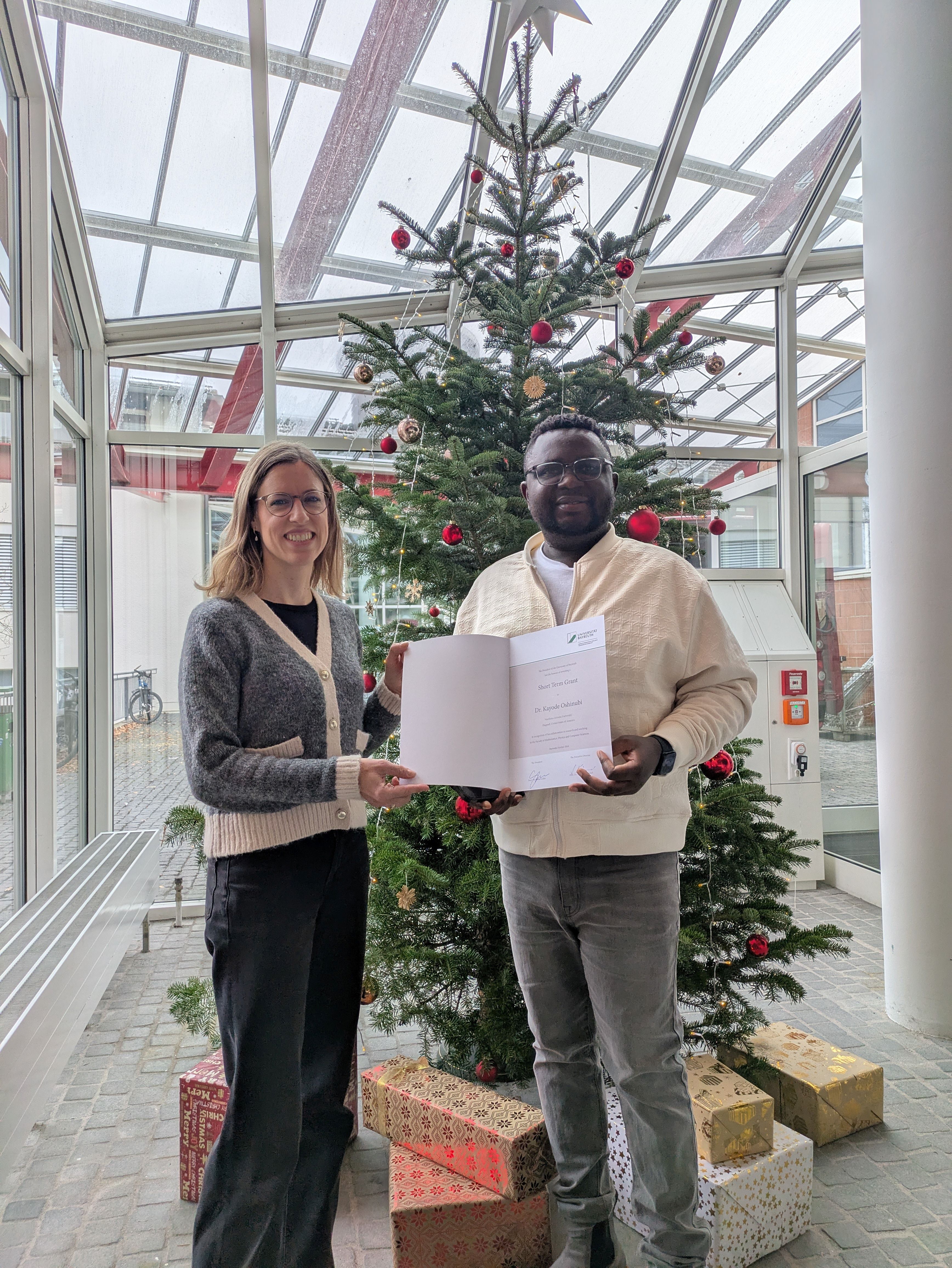
Dr. Kayode Oshinubi and Susanne Lopez
If you had to explain the research project of your Short Term Grant to the person you metin the elevator, how would you describe it?
Kayode Oshinubi: My project is about turning wastewater into an early-warning system for viral diseases like COVID-19. We collect daily measurements of virus levels from sewage treatment plants across Germany and treat them as smooth curves rather than isolated numbers. By using advanced statistical methods called functional data analysis, we can detect hidden patterns in how the virus spreads over time and across regions. We then connect these patterns to socio-economic factors (like population density or tourism) and climate variables (temperature and rainfall) to understand why some cities or regions show persistent virus signals long after others have cleared up. The goal is to help public health officials spot outbreaks faster and target interventions more effectively.
Was there a special moment in your life that made you decide for your research focus?
KO: During my first year as an undergraduate, I took a course on mathematical modeling and saw how a relatively simple equation could predict the spread of diseases like measles or influenza. That moment was eye-opening: I realised mathematics and statistics aren’t just abstract tools—they can literally save lives by helping us understand and control epidemics. From then on, I knew I wanted to work at the interface of statistics and real-world public health problems. The possibility of turning raw data into actionable insights that protect communities has kept me motivated ever since.
What is in your opinion the future of your field? In what way can research in your field contribute to meeting the urgent challenges of our time?
KO: The future of statistics and public health modeling lies in integrating increasingly complex, high-dimensional data—wastewater, air quality, mobility patterns, climate records, social media signals—into real-time, predictive systems. We’re moving from looking at yesterday’s outbreaks to forecasting tomorrow’s risks. My field can play a central role in meeting urgent global challenges: early detection of emerging pathogens, more equitable resource allocation during epidemics, and better preparedness for climate-driven disease shifts (e.g. dengue or cholera expanding into new regions). By combining robust statistical methods with environmental and social data, we can help build healthier, more resilient societies and reduce the human and economic cost of future pandemics.
What does international research mobility in today's world mean to you?
KO: For me, international research mobility means building bridges between people, ideas, and ways of working. It’s not just about accessing new data or equipment—it’s about learning from different scientific cultures, challenging your own assumptions, and discovering approaches you would never have thought of alone. During my stay in Bayreuth, collaborating with the local team gave me fresh perspectives on functional data methods and wastewater surveillance, while the everyday interactions—coffee breaks, seminars, weekend trips—created real human connections. I also experienced German culture through Christmas markets, local food, and conversations with colleagues. These exchanges enrich both the science and the scientist, and they make global challenges feel more solvable because we’re tackling them together.
What was your personal experience during your stay?
KO: Bayreuth was a wonderful surprise—much warmer and more welcoming than I expected for a small university town. The Christmas market was magical; walking through the lights and stalls with mulled wine became a weekly ritual I looked forward to. I also loved the Italian restaurant my colleagues took me to—it was fantastic food and even better company. One of the most practical things I enjoyed was the subsidized canteen at the university: excellent meals at very reasonable prices, which made daily life easy and social. Overall, it was a perfect balance of serious research and genuine quality of life.